· Alvarez, E.; Franch, X.; Martí-Henneberg, J., (2013). Evolution of the Territorial Coverage of the Railway Network and its Influence on Population Growth: The Case of England and Wales, 1871–1931. Historical Methods: A Journal of Quantitative and Interdisciplinary History, 46(3), 175–191. https://doi.org/10.1080/01615440.2013.804788
· Azhdari, A.; Taghvaee, A.A.; Kheyroddin, R., (2018). Spatiotemporal analysis of Shiraz metropolitan area expansion during 1986–2014: Using remote sensing imagery and landscape metrics. International Journal of Architectural Engineering & Urban Planning, 28(2), 163–173. https://doi.org/10.22068/ijaup.28.2.163
· Baum-Snow, N., (2007). Did highways cause suburbanization? The Quarterly Journal of Economics, 122(2), 775-805. https://academic.oup.com/qje/article/122/2/775/1942140
· Chester, M.V.; Horvath, A., (2009). Environmental assessment of passenger transportation should include infrastructure and supply chains. Environmental Research Letters, 4(2), 024008. https://doi.org/10.1088/1748-9326/4/2/024008
· Douvartzides, S.; Charisiou, N.D.; Wang, W.; Papadakis, V.G.; Polychronopoulou, K.; Goula, M.A., (2022). Catalytic fast pyrolysis of agricultural residues and dedicated energy crops for the production of high energy density transportation biofuels. Part I: Chemical pathways and bio-oil upgrading. Renewable Energy, 185, 483–505. https://doi.org/10.1016/j.renene.2021.12.083
· Imani Shamloo, J.; Dargahi, F.; Hatami Habashi, P.; Jamshidi Farkhondeh, R., (2023). Evaluation of the position of Tabriz city from the perspective of Islamic city model with emphasis on social justice. Culture of Islamic Architecture and Urbanism Journal, 175-192. https://www.ciauj-tabriziau.ir/article-1-456-en.html
· Kheyroddin, R.; Ghaderi, M., (2023). Railways and urban expansion: How does rail transport affect urban expansion in metropolitan areas? (Warsaw and Copenhagen case). International Planning Studies, 28(2), 124–141. https://doi.org/10.1080/13563475.2022.2137476
· Kheyroddin, R.; Kamali, J.; Alehashemi, A., (2026). A Discontinuous Landscape along the Tehran–Mashhad Railway Corridor (Within Tehran City Boundaries). Urban Strategic Thought. https://doi.org/10.30479/ust.2026.23161.1247
· Kheyroddin, R.; Abbaspour Kalmarzi, M., (2019). Ecological Tourism Development Model of Impassable Mountainous Areas in the Context of the Ancient Infrastructure of the Railway Network (Case study: Tehran-Mazandaran railway). Quarterly Journals of Urban and Regional Development Planning, 4(9), 1-36. doi: 10.22054/urdp.2021.58483.1285
· Kheyroddin, R.; Haghpannah, M., (2021). Rail-based spatial framework planning for metropolitan areas to control unbalanced urban sprawl (case study: rail-based development of Mashhad-Golbahar corridor). Proceedings of the 7th International Conference on Recent Advances in Railway Engineering (ICRARE 2021) pp. 1-26. Tehran: Iran University of Science and Technology. https://civilica.com/doc/1235897
· Kheyroddin, R.; Rezapour, M., (2016). Informal economy and urban spatial changes in the border town Baneh: a case study from the Iranian-Iraqi border. Int. J. Contemporary Economics and Administrative Sciences, 6(1), 66-86. http://www.ijceas.com/index.php/ijceas/article/view/104
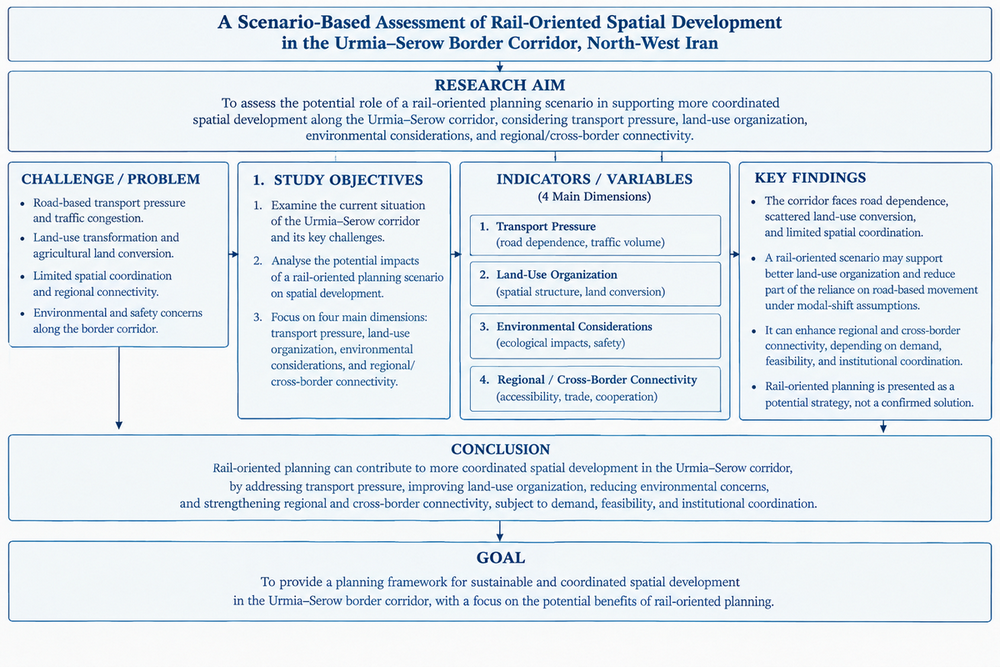
· Kheyroddin, R.; Jamshidi Farkhondeh, R., (2024). Planning via rail-based development of the axis of Urmia-Serow in order to regional sustainable environment. Proceedings of the First National Conference on Sustainability in Man-Made Environments, Isfahan. https://civilica.com/doc/2004047/
· Kheyroddin, R.; Naderi, M., (2016). Success and failure in metropolitan regions organization comparative comparison of east pivot of metropolis Tehran and east pivot of metropolis Paris. Bagh-e Nazar, 12(37), 17-30. https://www.bagh-sj.com/article_12920.html?lang=en
· Kheyroddin, R.; Piroozi, R., (2013). Development of rail corridor transportation in metropolitan areas. Proceedings of the 3rd International Conference on Recent Advances in Railway Engineering. Tehran: Iran University of Science and Technology. https://www.en.symposia.ir/ICRARE03
· Kheyroddin, R.; Piroozi, R.; Soleimani, A., (2017). Metastatic spread of luxury second homes in rural areas: a new type of spatial development in the Tehran metropolitan region: a study of Damavand County, Iran. Journal of Architectural and Planning Research, 34(1), 71-88. https://www.jstor.org/stable/44987217?seq=1
· Kheyroddin, R.; Rahsaz, S.; Abbaspour Kalmarzi, M., (2020). Ecological Tourism Development in the Mountainous Regions and Historical Railway Network Capacities: Case Study: Tehran–Mazandaran Old Railway by Crossing the Alborz Mountain Range. Lucrările Seminarului Geografic “Dimitrie Cantemir”, 48(2), 186–206. https://doi.org/10.15551/lsgdc.v48i2.04
· Kotavaara, O.; Antikainen, H.; Räsänen, J., (2011). Population change and accessibility by road and rail networks: GIS and statistical approach to Finland 1970–2007. Journal of Transport Geography, 19(4), 926-935. https://www.sciencedirect.com/science/article/pii/S0966692310001948
· Maulat, J.; Krauss, A., (2014). Using contrats d’axe to coordinate regional rail transport, stations and urban development: from concept to practice. Town Planning Review, 85(2), 287-311. https://www.liverpooluniversitypress.co.uk/doi/10.3828/tpr.2014.18
· Rezapour, M.; Kheyroddin, R.; Daneshpour, A.A., (2018). Explaining a different kind of informal space production in Baneh border County; capital accumulation and poverty. Journal of Fine Arts: Architecture and Urban Planning. https://jfaup.ut.ac.ir/article_65693.html?lang=en
· Rosik, P.; Wójcik, J., (2023). Transport infrastructure and regional development: a survey of literature on wider economic and spatial impacts. Sustainability, 15(1), 548. https://www.mdpi.com/2071-1050/15/1/548
· Wang, Z.; Han, Q.; de Vries, B.; Dai, L., (2021). Insights into the correspondence between land use pattern and spatial distribution of rail transit services. Applied Spatial Analysis and Policy, 14, 907-928. https://link.springer.com/article/10.1007/s12061-021-09385-4