Abd Razak, A., Hagishima, A., Ikegaya, N., & Tanimoto, J. (2013). Analysis of airflow over building arrays for assessment of urban wind environment. Building and Environment, 59, 56–65. https://doi.org/10.1016/j.buildenv.2012.08.007
Abdalla, I. E., Cook, M. J., Rees, S. J., & Yang, Z. (2007). Large-eddy simulation of buoyancy-driven natural ventilation in an enclosure with a point heat source. International Journal of Computational Fluid Dynamics, 21(5–6), 231–245. https://doi.org/10.1080/10618560701599710
Ahmadi, M., & Khosravi Farsani, A. (2020). Computational fluid simulation of non-Newtonian two-phase fluid flow through a channel with a cavity. Thermal Science, 24(2B), 1045–1054. https://doi.org/10.2298/TSCI180102151A
Ahmadi, M., Mirjalily, S. A. A., & Oloomi, S. A. A. (2019). A RANS k–ω simulation of 2D turbulent natural convection in an enclosure with heating sources. IIUM Engineering Journal, 20(1), 229–244. https://doi.org/10.31436/iiumej.v20i1.1040
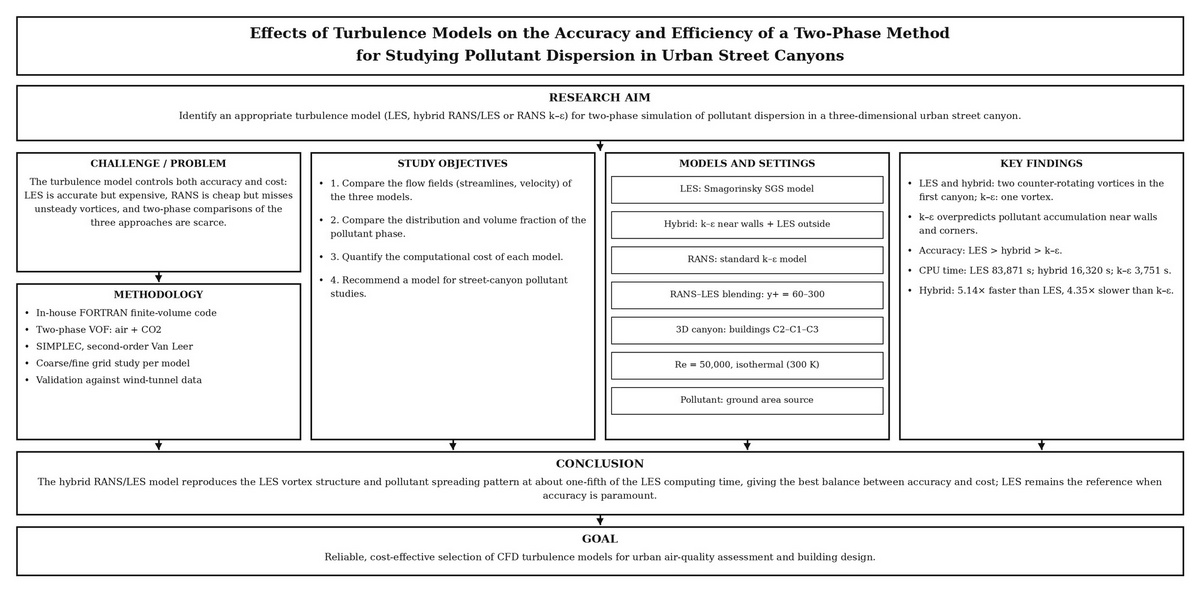
Ahmadi, M., Mirjalily, S. A. A., & Oloomi, S. A. A. (2020). Simulation of pollutant dispersion in urban street canyons using hybrid RANS-LES method with two-phase model. Computers & Fluids, 210, Article 104676. https://www.sciencedirect.com/science/article/pii/S0045793020302474
Aland, S., & Voigt, A. (2012). Benchmark computations of diffuse interface models for two-dimensional bubble dynamics. International Journal for Numerical Methods in Fluids, 69(3), 747–761. https://doi.org/10.1002/fld.2611
Allegrini, J., & Carmeliet, J. (2018). Simulations of local heat islands in Zürich with coupled CFD and building energy models. Urban Climate, 24, 340–359. https://www.sciencedirect.com/science/article/pii/S221209551730010X
Allmaras, S. R., Johnson, F. T., & Spalart, P. R. (2012). Modifications and clarifications for the implementation of the Spalart–Allmaras turbulence model. In Proceedings of the Seventh International Conference on Computational Fluid Dynamics (ICCFD7) (Paper ICCFD7-1902). https://iccfd.org/iccfd7/assets/pdf/papers/ICCFD7-1902_paper.pdf
American Institute of Aeronautics and Astronautics. (1998). Guide for the verification and validation of computational fluid dynamics simulations (AIAA G-077-1998). AIAA.
An, K., Fung, J. C. H., & Yim, S. H. L. (2013). Sensitivity of inflow boundary conditions on downstream wind and turbulence profiles through building obstacles using a CFD approach. Journal of Wind Engineering and Industrial Aerodynamics, 115, 137–149. https://doi.org/10.1016/j.jweia.2013.01.004
Anderson, J. D., Jr. (1995). Computational fluid dynamics: The basics with applications. McGraw-Hill.
Antoniou, N., Montazeri, H., Wigö, H., Neophytou, M. K.-A., Blocken, B., & Sandberg, M. (2017). CFD and wind-tunnel analysis of outdoor ventilation in a real compact heterogeneous urban area: Evaluation using “air delay”. Building and Environment, 126, 355–372. https://doi.org/10.1016/j.buildenv.2017.10.013
Awbi, H. B., & Setrak, A. A. (1986). Numerical solution of ventilation air jet. In Proceedings of the 5th Symposium on the Use of Computers for Environmental Engineering Related to Buildings. CIBSE.
Baetke, F., Werner, H., & Wengle, H. (1990). Numerical simulation of turbulent flow over surface-mounted obstacles with sharp edges and corners. Journal of Wind Engineering and Industrial Aerodynamics, 35, 129–147.
Baker, C. J. (2007). Wind engineering—Past, present and future. Journal of Wind Engineering and Industrial Aerodynamics, 95, 843–870. https://doi.org/10.1016/j.jweia.2007.01.011
Bazdidi-Tehrani, F., Ghafouri, A., & Jadidi, M. (2013). Grid resolution assessment in large eddy simulation of dispersion around an isolated cubic building. Journal of Wind Engineering and Industrial Aerodynamics, 121, 1–15. https://www.sciencedirect.com/science/article/pii/S0167610513001347
Blocken, B., Stathopoulos, T., & Carmeliet, J. (2007). CFD simulation of the atmospheric boundary layer: Wall function problems. Atmospheric Environment, 41(2), 238–252. https://doi.org/10.1016/j.atmosenv.2006.08.019
Blocken, B., Stathopoulos, T., & Carmeliet, J. (2008). Wind environmental conditions in passages between two long narrow perpendicular buildings. Journal of Aerospace Engineering, 21(4), 280–287. https://doi.org/10.1061/(ASCE)0893-1321(2008)21:4(280)
Blocken, B., Stathopoulos, T., & van Beeck, J. P. A. J. (2016). Pedestrian-level wind conditions around buildings: Review of wind-tunnel and CFD techniques and their accuracy for wind comfort assessment. Building and Environment, 100, 50–81. https://doi.org/10.1016/j.buildenv.2016.02.004
Brackbill, J. U., Kothe, D. B., & Zemach, C. (1992). A continuum method for modeling surface tension. Journal of Computational Physics, 100(2), 335–354. https://doi.org/10.1016/0021-9991(92)90240-Y
Brook, R. D., Franklin, B., Cascio, W., Hong, Y., Howard, G., Lipsett, M., Luepker, R., Mittleman, M., Samet, J., Smith, S. C., & Tager, I. (2004). Air pollution and cardiovascular disease: A statement for healthcare professionals from the Expert Panel on Population and Prevention Science of the American Heart Association. Circulation, 109(21), 2655–2671. https://doi.org/10.1161/01.CIR.0000128587.30041.C8
Chavez, M., Hajra, B., Stathopoulos, T., & Bahloul, A. (2011). Near-field pollutant dispersion in the built environment by CFD and wind tunnel simulations. Journal of Wind Engineering and Industrial Aerodynamics, 99(4), 330–339. https://doi.org/10.1016/j.jweia.2011.01.003
Deng, Q., Deng, L., Miao, Y., Guo, X., & Li, Y. (2019). Particle deposition in the human lung: Health implications of particulate matter from different sources. Environmental Research, 169, 237–245. https://doi.org/10.1016/j.envres.2018.11.014
Ding, H., & Yuan, C.-J. (2014). On the diffuse interface method using a dual-resolution Cartesian grid. Journal of Computational Physics, 273, 243–254. https://doi.org/10.1016/j.jcp.2014.05.005
Ferziger, J. H., & Perić, M. (1996). Computational methods for fluid dynamics. Springer.
Gao, N. P., Niu, J. L., Perino, M., & Heiselberg, P. (2009). The airborne transmission of infection between flats in high-rise residential buildings: Particle simulation. Building and Environment, 44(2), 402–410. https://doi.org/10.1016/j.buildenv.2008.03.016
Gousseau, P., Blocken, B., & van Heijst, G. J. F. (2011). CFD simulation of pollutant dispersion around isolated buildings: On the role of convective and turbulent mass fluxes in the prediction accuracy. Journal of Hazardous Materials, 194, 422–434. https://doi.org/10.1016/j.jhazmat.2011.08.008
He, C., Liu, Y., & Yavuzkurt, S. (2017). A dynamic delayed detached-eddy simulation model for turbulent flows. Computers & Fluids, 146, 174–189. https://doi.org/10.1016/j.compfluid.2017.01.018
Hirt, C. W., & Nichols, B. D. (1981). Volume of fluid (VOF) method for the dynamics of free boundaries. Journal of Computational Physics, 39(1), 201–225. https://doi.org/10.1016/0021-9991(81)90145-5
Holmes, S. A., Jouvray, A., & Tucker, P. G. (2000). An assessment of a range of turbulence models when predicting room ventilation. In Proceedings of Healthy Buildings 2000 (Vol. 2, pp. 401–406).
Huang, Y.-D., Xu, X., Liu, Z.-Y., Deng, J.-T., & Kim, C.-N. (2016). Impacts of shape and height of building roof on airflow and pollutant dispersion inside an isolated street canyon. Environmental Forensics, 17(4), 361–379. https://doi.org/10.1080/15275922.2016.1230912
Jadidi, A. M., & Heidarinejad, G. (2013). Evaluating DES and DDES models for wind flow over building and comparing with traditional turbulence models. Modares Mechanical Engineering, 14, 81–93.
Karra, S., Malki-Epshtein, L., & Neophytou, M. K.-A. (2017). Air flow and pollution in a real, heterogeneous urban street canyon: A field and laboratory study. Atmospheric Environment, 165, 370–384. https://doi.org/10.1016/j.atmosenv.2017.06.035
Khayrullina, A., van Hooff, T., Blocken, B., & van Heijst, G. J. F. (2017). PIV measurements of isothermal plane turbulent impinging jets at moderate Reynolds numbers. Experiments in Fluids, 58(4), Article 31. https://doi.org/10.1007/s00348-017-2315-0
Launder, B. E., & Spalding, D. B. (1972). Lectures in mathematical models of turbulence. Academic Press.
Li, X.-X., Leung, D. Y. C., Liu, C.-H., & Lam, K. M. (2008). Physical modeling of flow field inside urban street canyons. Journal of Applied Meteorology and Climatology, 47(7), 2058–2067. https://doi.org/10.1175/2007JAMC1815.1
Meroney, R. N. (2016). Ten questions concerning hybrid computational/physical model simulation of wind flow in the built environment. Building and Environment, 96, 12–21. https://www.sciencedirect.com/science/article/pii/S0360132315301682
Meroney, R. N., & Derickson, R. (2014). Virtual reality in wind engineering: The windy world within the computer. Journal of Wind and Engineering, 11(2), 11–26.
Mockett, C., Haase, W., & Schwamborn, D. (Eds.). (2018). Go4Hybrid: Grey area mitigation for hybrid RANS-LES methods (Notes on Numerical Fluid Mechanics and Multidisciplinary Design, Vol. 134). Springer. https://doi.org/10.1007/978-3-319-52995-0
Nardell, E. A., Keegan, J., Cheney, S. A., & Etkind, S. C. (1991). Airborne infection: Theoretical limits of protection achievable by building ventilation. American Review of Respiratory Disease, 144, 302–306.
Neophytou, M. K.-A., Markides, C. N., & Fokaides, P. A. (2014). An experimental study of the flow through and over two-dimensional rectangular roughness elements: Deductions for urban boundary layer parameterizations and exchange processes. Physics of Fluids, 26(8), Article 086603. https://doi.org/10.1063/1.4892979
Partridge, J. L., & Linden, P. F. (2013). Validity of thermally-driven small-scale ventilated filling box models. Experiments in Fluids, 54, Article 1613. https://doi.org/10.1007/s00348-013-1613-4
Patankar, S. V. (1980). Numerical heat transfer and fluid flow. Hemisphere.
Pournazeri, S., Princevac, M., & Venkatram, A. (2012). Scaling of building affected plume rise and dispersion in water channels and wind tunnels—Revisit of an old problem. Journal of Wind Engineering and Industrial Aerodynamics, 103, 16–30. https://doi.org/10.1016/j.jweia.2012.01.006
Rafailidis, S., & Schatzmann, M. (1995). Study on different roof geometries in a simplified urban environment [Wind-tunnel data report]. Meteorological Institute, University of Hamburg.
Ricci, A., Burlando, M., Freda, A., & Repetto, M. P. (2017). Wind tunnel measurements of the urban boundary layer development over a historical district in Italy. Building and Environment, 111, 192–206. https://doi.org/10.1016/j.buildenv.2016.10.016
Riley, E. C., Murphy, G., & Riley, R. L. (1978). Airborne spread of measles in a suburban elementary school. American Journal of Epidemiology, 107(5), 421–432. https://doi.org/10.1093/oxfordjournals.aje.a112560
Sajjadi, H., Salmanzadeh, M., Ahmadi, G., & Jafari, S. (2017). Turbulent indoor airflow simulation using hybrid LES/RANS model utilizing lattice Boltzmann method. Computers & Fluids, 150, 66–73. https://www.sciencedirect.com/science/article/pii/S0045793017301093
Shur, M. L., Spalart, P. R., Strelets, M. K., & Travin, A. K. (2015). An enhanced version of DES with rapid transition from RANS to LES in separated flows. Flow, Turbulence and Combustion, 95(4), 709–737. https://doi.org/10.1007/s10494-015-9618-0
Soligo, G., Roccon, A., & Soldati, A. (2019). Mass-conservation-improved phase field methods for turbulent multiphase flow simulation. Acta Mechanica, 230, 683–696. https://doi.org/10.1007/s00707-018-2304-2
Spalart, P. R., Jou, W.-H., Strelets, M., & Allmaras, S. R. (1997). Comments on the feasibility of LES for wings, and on a hybrid RANS/LES approach. In Proceedings of the First AFOSR International Conference on DNS/LES. Greyden Press.
Tian, Z. F., Tu, J. Y., Yeoh, G. H., & Yuen, R. K. K. (2006). On the numerical study of contaminant particle concentration in indoor airflow. Building and Environment, 41(11), 1504–1514. https://doi.org/10.1016/j.buildenv.2005.06.006
Tominaga, Y., & Stathopoulos, T. (2010). Numerical simulation of dispersion around an isolated cubic building: Model evaluation of RANS and LES. Building and Environment, 45(10), 2231–2239. https://www.researchgate.net/publication/223403188_Numerical_simulation_of_dispersion_around_an_isolated_cubic_building_Model_evaluation_of_RANS_and_LES
Tominaga, Y., & Stathopoulos, T. (2016). Ten questions concerning modeling of near-field pollutant dispersion in the built environment. Building and Environment, 105, 390–402. https://www.sciencedirect.com/science/article/pii/S0360132316302347
Tsang, C. W., Kwok, K. C. S., & Hitchcock, P. A. (2012). Wind tunnel study of pedestrian level wind environment around tall buildings: Effects of building dimensions, separation and podium. Building and Environment, 49, 167–181. https://doi.org/10.1016/j.buildenv.2011.08.014
van Leer, B. (1979). Towards the ultimate conservative difference scheme. V. A second-order sequel to Godunov's method. Journal of Computational Physics, 32(1), 101–136. https://www.sciencedirect.com/science/article/abs/pii/0021999179901451
Wang, M., Lin, C.-H., & Chen, Q. (2012). Advanced turbulence models for predicting particle transport in enclosed environments. Building and Environment, 47, 40–49. https://www.sciencedirect.com/science/article/pii/S0360132311001661
Wang, Y., Shu, C., Shao, J. Y., Wu, J., & Niu, X. D. (2015). A mass-conserved diffuse interface method and its application for incompressible multiphase flows with large density ratio. Journal of Computational Physics, 290, 336–351. https://www.sciencedirect.com/science/article/pii/S0021999115001382
Wang, Y., Shu, C., Yang, L. M., & Yuan, H. Z. (2018). On the re-initialization of fluid interfaces in diffuse interface method. Computers & Fluids, 166, 209–217. https://www.sciencedirect.com/science/article/pii/S0045793018300768
World Health Organization. (2000). Air quality guidelines for Europe (2nd ed.). WHO Regional Office for Europe.
Xie, X., Huang, Z., & Wang, J. (2006). The impact of urban street layout on local atmospheric environment. Building and Environment, 41(10), 1352–1363. https://www.sciencedirect.com/science/article/pii/S0360132305002003
Xu, J., Li, M., & Gao, G. (2017). A dynamic hybrid RANS/LES approach based on the local flow structure. International Journal of Heat and Fluid Flow, 67, 250–260. https://www.sciencedirect.com/science/article/pii/S0142727X17308226
You, D., & Moin, P. (2007). A dynamic global-coefficient subgrid-scale eddy-viscosity model for large-eddy simulation in complex geometries. Physics of Fluids, 19(6), Article 065110. https://doi.org/10.1063/1.2739419
Yu, Y., Kwok, K. C. S., Liu, X. P., & Zhang, Y. (2017). Air pollutant dispersion around high-rise buildings under different angles of wind incidence. Journal of Wind Engineering and Industrial Aerodynamics, 167, 51–61. https://doi.org/10.1016/j.jweia.2017.04.006