Document Type : Original Article
Authors
Department of Civil Engineering and Architecture, University of Torbat Heydarieh, Torbat Heydarieh, Iran
Abstract
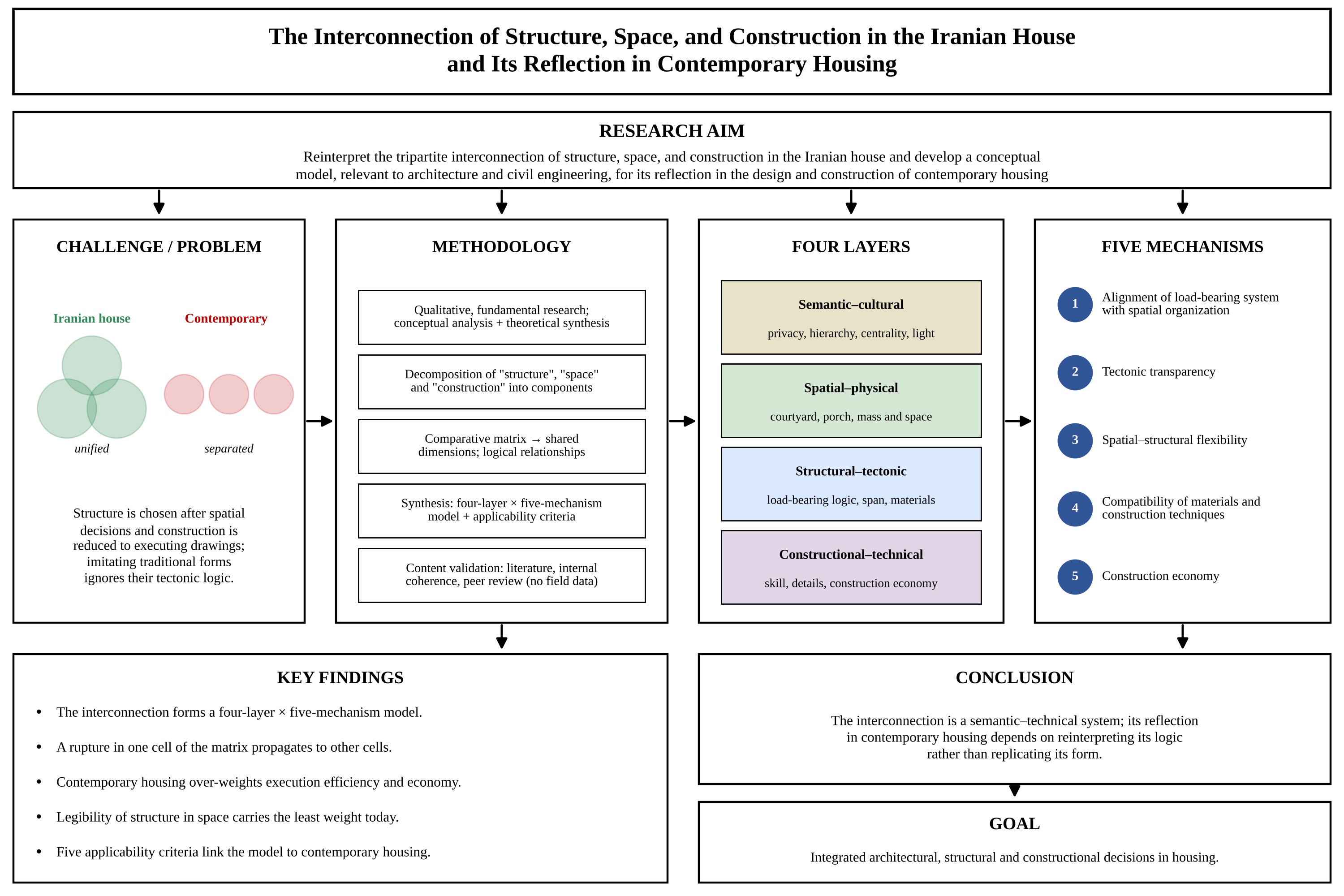
The Iranian house has long integrated structure, space, and construction within a unified tectonic logic. In contemporary Iranian housing, new building systems, regulations, and industrialized processes have separated these systems: structure is often selected after spatial decisions are made, and construction is reduced to implementing drawings, so this unity has become an imitative, concealed, or merely technical pattern. Without understanding this logic, the formal transfer of traditional elements remains ineffective. This study therefore aims to extract the principles and mechanisms of this tripartite interconnection and to develop a conceptual model, relevant to both architecture and civil engineering, for its reflection in contemporary housing. The research is qualitative and fundamental and uses conceptual analysis and theoretical synthesis: the core concepts were decomposed into components, compared to identify shared dimensions, examined for logical relationships, and synthesized into a model. Validity was assessed through conformity with the literature, internal coherence, and peer review; no field data were used. The findings show that the interconnection operates across four layers: semantic–cultural, spatial–physical, structural–tectonic includes, load-bearing logic, span, vernacular materials, and structural expression, and constructional–technical. These layers are linked through five mechanisms: alignment of the load-bearing system with spatial organization, tectonic transparency, spatial–structural flexibility, compatibility of materials and construction techniques, and construction economy. The study concludes that the interconnection is a semantic–technical system whose reflection in contemporary housing depends on reinterpreting its logic rather than replicating its form.
Graphical Abstract
Highlights
· Structure, space and construction formed one tectonic system in the Iranian house.
· A four-layer × five-mechanism conceptual model of this interconnection is proposed.
· Rupture in one layer–mechanism cell propagates to other cells of the model.
· Contemporary housing over-weights economy and under-weights structural legibility.
· Reinterpreting tectonic logic, not copying form, links tradition to new housing.
Keywords